
Clinical Nursing Care for Patients with Limb Fractures Immobilized with Kangda Orthopedic Fiberglass Casting Tape
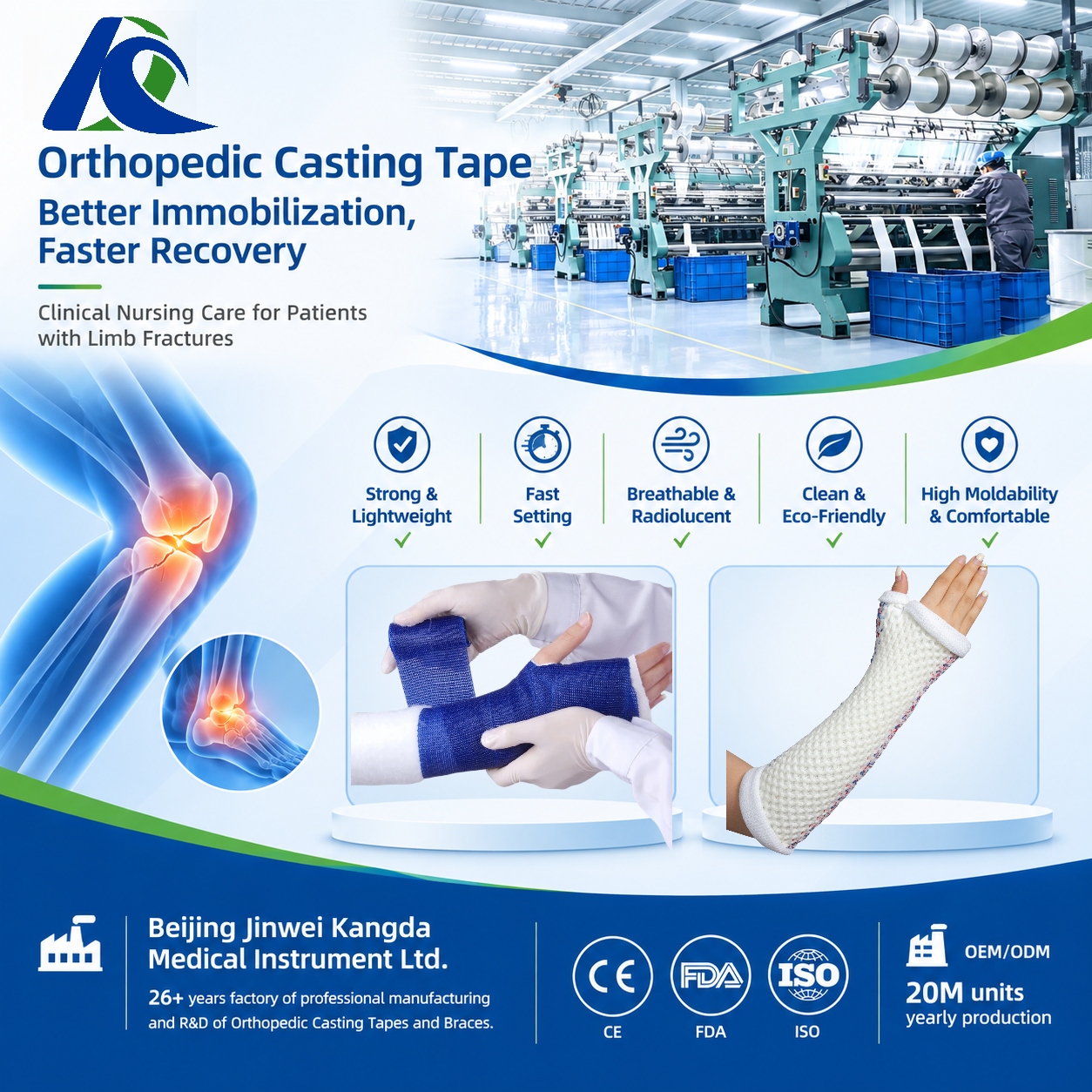
【Abstract】 Objective: To observe and study the clinical application of Orthopedic Fiberglass Casting Tape for immobilizing patients with limb fractures. Methods: A total of 132 patients with limb fractures were studied. Comparisons were made between patients immobilized with Orthopedic Fiberglass Casting Tape and those treated with traditional plaster casts regarding setting characteristics, patient comfort, nursing requirements, and other factors. Results: Among patients immobilized with Orthopedic Fiberglass Casting Tape, there were no instances of allergic reactions, compression injuries, or cast breakage. The material exhibited a short setting time and facilitated good fracture healing; the overall outcome was significantly superior to that of the traditional plaster cast group (P<0.01). Conclusion: Compared to traditional plaster casts, Orthopedic Fiberglass Casting Tape offers advantages such as strength, lightness, rapid setting, breathability, radiolucency, cleanliness, hygiene, eco-friendliness, high moldability, ease of application, and a lack of irritation or allergic reactions. It provides greater comfort and facilitates the nursing care and observation of the fractured limb, thereby supporting effective nursing interventions and promoting early fracture healing and functional recovery.
【Keywords】 Limb fractures; Immobilization; Nursing care; Orthopedic Fiberglass Casting Tape; Cast Tape
Plaster casts and splints are traditional methods for the external immobilization of limb fractures. Plaster immobilization is cost-effective and easy to mold; however, once set, the cast cannot be adjusted, and it is prone to softening due to moisture absorption and breakage. The hardening rate of traditional plaster bandages depends on water temperature and the addition of salt. To accelerate hardening during application, the bandages are typically soaked in 40°C warm water with a small amount of added salt. High-quality plaster bandages should set within approximately 5–10 minutes and fully dry within 24–48 hours [2]. Splints offer advantages such as continuous adjustability, the ability to maintain fracture reduction, and the facilitation of functional exercises; however, they also present potential issues, such as insufficient immobilization stability in some cases or the risk of localized pressure injuries due to improper placement of padding. To address the aforementioned shortcomings, orthopedic Fiberglass Casting Tape is increasingly being used in clinical practice. This paper presents a comparative study conducted by our department since January 2007, evaluating the immobilization characteristics and nursing requirements of orthopedic Fiberglass Casting Tape versus traditional plaster bandages.
1 Materials and Methods
1.1 General Information
Between January 2007 and October 2008, our department treated 132 patients with limb fractures (87 males, 45 females; age range: 15–82 years). The cases included fractures of the tibia/fibula (42), humerus (35), radius/ulna (29), distal radius (Colles' fracture) (15), and fingers (11). Two groups of 66 patients were randomly selected for the study to compare traditional plaster casts and orthopedic fiberglass casting tape in terms of curing speed, structural stability, ease of use, and patient comfort (evaluation criteria are listed in Table 1); nursing care requirements were also analyzed. Statistical analysis was performed, with P<0.01 indicating a significant difference.
1.2 Application Method for Orthopedic Fiberglass Casting Tape
1.2.1 Select the appropriate size based on the area requiring immobilization.
1.2.2 Apply cotton padding or a stockinette to the area to be immobilized.
1.2.3 Wear latex gloves.
1.2.4 Open the package, remove the tape, soak it in room-temperature water for 2–3 minutes while squeezing it 2–3 times, and then remove it and squeeze out excess water.
1.2.5 Wrap the tape spirally as needed, maintaining moderate tension; apply 3–4 layers for non-weight-bearing areas and 4–5 layers for weight-bearing areas.
1.2.6 Mold the cast as required; the setting time is 3–5 minutes, so molding must be completed within this period. Full weight-bearing is possible after 20 minutes.
1.2.7 Remove using a standard electric cast saw.
2 Results
Clinical observations indicated that orthopedic fiberglass casting tape cured significantly faster than traditional plaster bandages and was superior in terms of stability, convenience, and comfort. Among the 66 patients treated with orthopedic fiberglass casting tape, there were no instances of allergic reactions, compression injuries, or cast breakage; the curing time was short, fracture healing was satisfactory, and no cases of non-union occurred. Table 1 presents a comparison of the two types of casting materials regarding stability, convenience, comfort, incidence of compression or breakage, and curing time (P < 0.01).
Affiliation: Department of Surgery, Kaiping Hospital of Traditional Chinese Medicine